AI Glossary: 55 Artificial Intelligence Terms Explained Simply (2026)
Every term you hear in the world of AI, from tokens and prompts to large language models, hallucinations, RAG and AI agents, explained simply with examples in this glossary, organised into six topics from the basics to safety and law.
Who is this glossary for? Anyone who keeps running into words like "token", "prompt" or "large language model" in conversations, news or AI tools and wants to understand them without a technical background. Each term comes with a plain definition and, where it helps, an example.
If you are new to AI, start with our guide What Is Artificial Intelligence and How Does It Work? and keep this page as your reference.
How to use this glossary
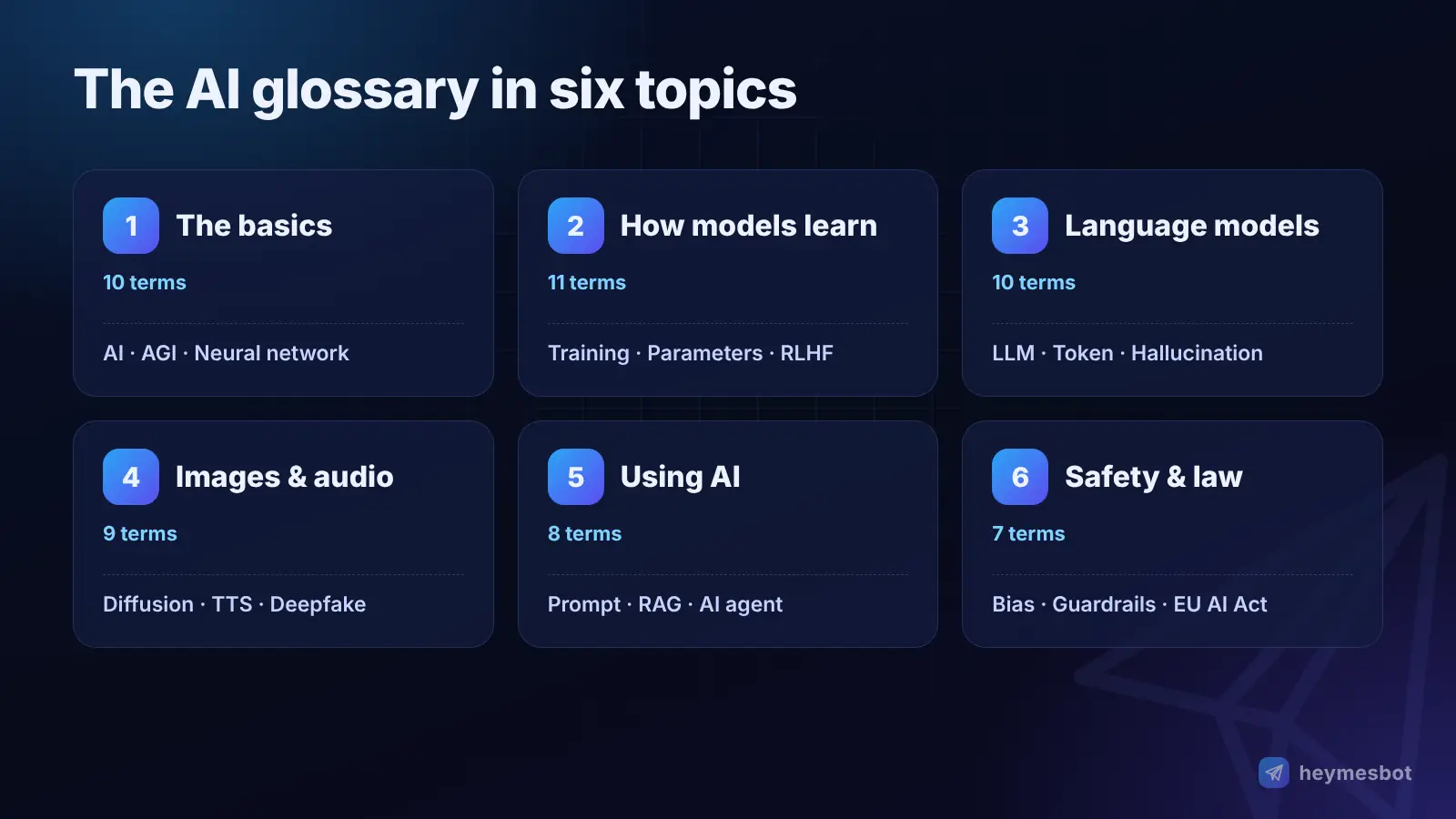
Terms are grouped into six topics, from the basics to safety and law
Common abbreviations (LLM, RAG, AGI…) are spelled out next to each term
To find a term quickly, use your browser's search (Ctrl+F or Cmd+F)
1. The basics
Artificial intelligence (AI)
Software that learns patterns from data instead of following pre-written rules, and uses them for tasks such as understanding language, recognising images or creating content. It is also the name of the whole field.
Narrow AI
AI that is good at one or a few specific tasks, such as translation, face recognition or conversation. Every AI tool in use today, even the most advanced chatbots, is narrow AI.
Artificial general intelligence (AGI)
A hypothetical AI that could learn and perform almost any intellectual task a human can, in any field. AGI is a research goal for many labs, but it does not exist yet and there is no agreement on when it might arrive.
Artificial superintelligence (ASI)
A hypothetical AI that would surpass the smartest humans in almost every area. It comes up mainly in discussions about the future and AI safety.
Algorithm
A precise set of steps for solving a problem. In AI, algorithms define how learning happens, and the result of that learning is a "model".
Model
The output of training an AI system: a file of millions to billions of numbers in which the model's knowledge is compressed. When people say "a new model has been released", they mean this trained file.
Machine learning (ML)
The branch of AI in which a machine learns from examples instead of being explicitly programmed. Email spam filters and streaming recommendations are everyday examples.
Deep learning
A type of machine learning that uses neural networks with many layers. The big breakthroughs of the past decade, from speech recognition to chatbots, come from deep learning.
Neural network
A structure inspired by the brain, made of layers of artificial "neurons". Each neuron combines numbers using different weights and passes the result to the next layer. The 2024 Nobel Prize in Physics went to pioneers of this idea.
Generative AI
Models that create new content: text, images, video, audio or code. ChatGPT and image and music generators are examples of generative AI.
2. How models learn
Training data
The examples a model learns from, such as text, images or audio. The quality and diversity of training data directly affect a model's accuracy and bias.
Training
The process in which a model repeatedly makes a guess, the guess is compared with the right answer, and its parameters are adjusted slightly. Training large models takes weeks or months on thousands of processors.
Pre-training
The first stage of training large models, in which the model sees a vast amount of general data and learns broad patterns before being tuned for any specific task.
Parameters (weights)
The numbers inside a model that are adjusted during training and hold what it has learned. Large language models have billions of parameters, but more parameters do not always mean a better model.
Supervised learning
Learning from examples whose correct answers are known, such as thousands of photos labelled "cat" or "dog". The model learns to get from input to the right answer.
Unsupervised learning
Learning from unlabelled data to find patterns or groups, for example automatically grouping customers by their buying behaviour.
Reinforcement learning
A method in which a model learns by trial and error, receiving "rewards" or "penalties" for its actions. AlphaGo used this approach to beat the world champion at the game of Go.
Reinforcement learning from human feedback (RLHF)
A stage of chatbot training in which people rank different model answers and the model learns to give more helpful, honest and harmless ones.
Fine-tuning
Extra training of an already trained model on more specialised data so it performs better at a particular task or domain, for example tuning a general model for legal documents.
Overfitting
When a model memorises its training examples instead of learning the general pattern: it does brilliantly on training data but poorly on new data. Like a student who memorised the answers without understanding the subject.
Inference
The stage of using a trained model: it takes new input and produces an answer. Every time you talk to a chatbot, the model is running inference and is not learning from you.
3. Language models and chatbots
Large language model (LLM)
A very large neural network trained on huge amounts of text to predict the next word. That simple ability underpins the writing, summarising, translating and conversation of chatbots.
Transformer
The neural network architecture introduced in the 2017 paper Attention Is All You Need, the foundation of almost every large language model today. It is also the "T" in GPT.
Attention mechanism
The part of a transformer that lets the model work out, for each word, which other words in the text matter most, for example which noun the word "it" refers to.
Token
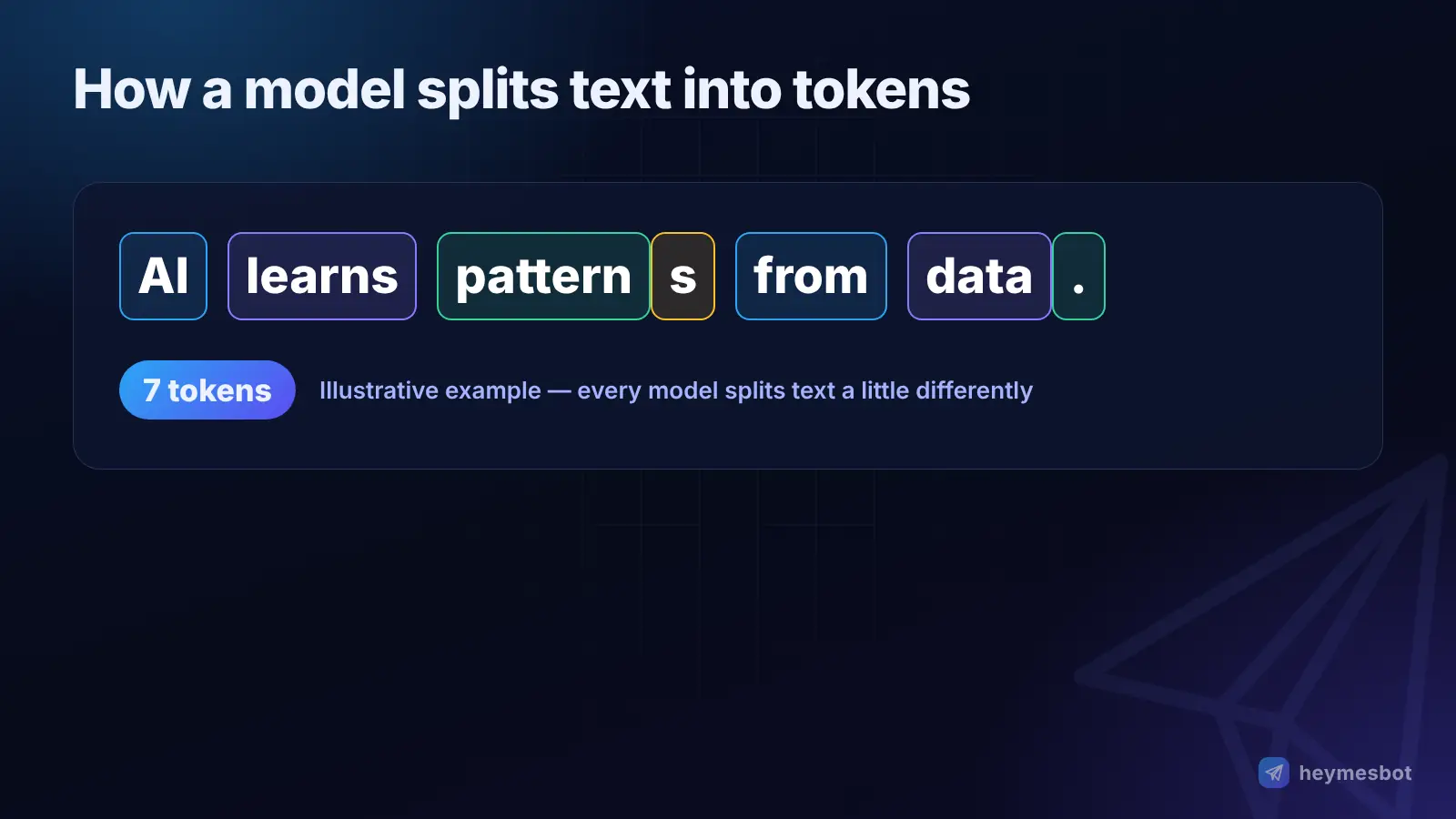
The smallest piece of text a model works with: a word, part of a word or a punctuation mark. In English one token is roughly three-quarters of a word; in many other languages a word is often split into several tokens. Usage costs and length limits are measured in tokens.
Context window
The maximum amount of text, measured in tokens, that a model can "see" at once, including earlier messages and attached documents. If a conversation grows beyond it, the oldest parts drop out of the model's working memory.
Embedding
A way of turning a word, sentence or image into a list of numbers so that similar meanings end up with similar numbers. Semantic search and RAG are built on embeddings.
Temperature
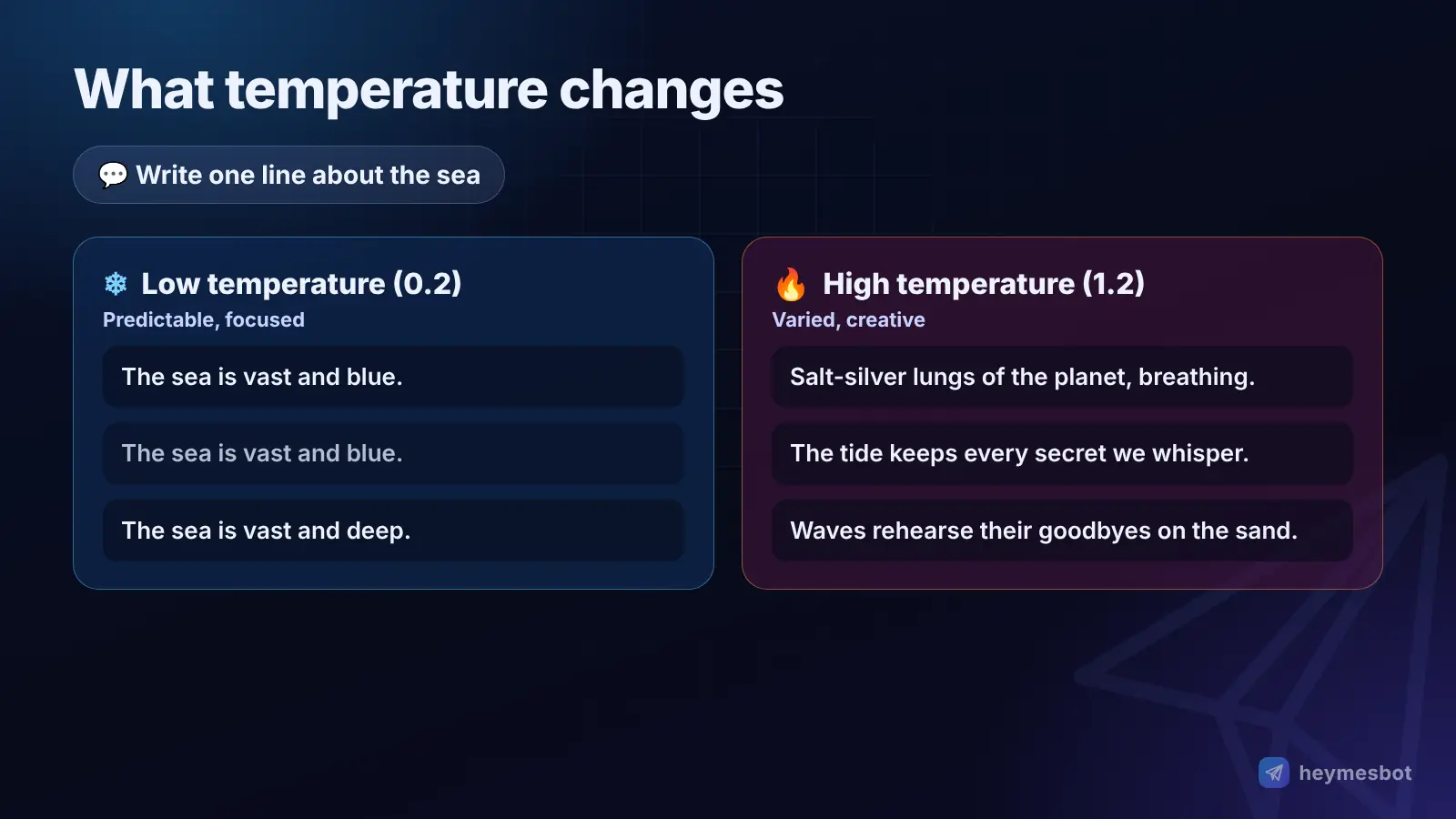
A setting that controls how random a model's answers are. Low temperature gives more predictable, focused answers; high temperature gives more varied, creative ones.
Hallucination
When a model gives a fluent, convincing answer that is wrong or invented, such as a statistic that doesn't exist or a fake source. It happens because the model is trained to produce plausible text, not to check facts.
Chatbot
A program that talks with users in natural language. Today's chatbots are usually built on large language models.
Reasoning model
A language model that works through a problem step by step before giving its final answer. These models are better at maths, coding and multi-step problems, but are usually slower and more expensive.
4. Images, video and audio
Diffusion model
The main technique behind most of today's image generators. The model has learned to remove noise from an image step by step; to generate, it starts from pure random noise and, guided by your text, turns it into a picture.
Text-to-image
Creating an image from a text description, for example "a lighthouse at sunset, in watercolour".
AI image editing (inpainting)
Changing part of an existing image with a text instruction, such as removing an object, replacing the background or adding detail, without touching the rest of the picture.
Text-to-video
Creating a short video from a text description or an image. Because frames must stay consistent over time, video costs far more to generate than a still image.
Text-to-speech (TTS)
Turning written text into natural-sounding speech with appropriate tone and pauses. It is used for audiobooks, video voice-overs and voice assistants.
Speech-to-text (ASR)
Turning spoken audio into written text, as in automatic subtitles or voice typing. ASR stands for automatic speech recognition.
Voice cloning
Using AI to create a voice that sounds like a specific person. Because of the risk of misuse and the rights of the voice's owner, most reputable services restrict imitating real people's voices without permission.
Deepfake
A fake but realistic image, audio clip or video made with AI to show someone saying or doing something they never did. Don't trust shocking content without a reliable source.
Multimodal
A model that understands or produces several kinds of data together, for example looking at a photo and talking about it, or creating images and audio from text.
5. Using AI
Prompt
The text or instruction you give an AI: a question, a request or an image description. The quality of the prompt has a direct effect on the quality of the result.
Prompt engineering
The skill of writing prompts that get the best results, for example by specifying a role, goal, audience and output format, and by giving examples.
System prompt
A hidden instruction that a chatbot's maker gives the model at the start of every conversation to set its behaviour, tone and limits.
Zero-shot and few-shot prompting
In zero-shot prompting you only state the request; in few-shot prompting you also give a few examples of the input and output you want so the model picks up the pattern. A few good examples often improve results dramatically.
Retrieval-augmented generation (RAG)
A technique in which the model first looks up relevant information in an outside source, such as company documents or a web search, and builds its answer from it. This keeps answers more current and reduces hallucinations.
AI agent
A system that doesn't just answer but plans and carries out several steps on its own to reach a goal: searching, using tools, creating files and checking the result.
API (application programming interface)
The way software connects directly to an AI model and uses it. Many apps and bots use big companies' models through an API, usually paying per token.
Open-source / open-weight model
A model whose parameters have been released publicly, so anyone can download it, run it on their own server or fine-tune it. Closed models are only available through their maker's service or API.
6. Safety, ethics and law
Bias
A model's tendency towards unfair or one-sided results, usually because of imbalance or prejudice in its training data, for example always picturing a certain job with one gender.
Alignment
The effort to make an AI's behaviour match human goals and values, so that it stays helpful, honest and harmless and does what we actually mean.
Guardrails (safety filters)
Rules and filters that model makers use to prevent dangerous, illegal or harmful output. When a tool refuses a request "due to content restrictions", it is usually the model maker's guardrails at work.
Jailbreak
An attempt to trick a model with special prompts into ignoring its safety limits. Model makers keep identifying and blocking these techniques, and using them usually breaks a service's terms.
AI watermarking and content labelling
Visible or hidden marks placed in AI-generated content so its origin can be identified. New rules, including the EU AI Act, are moving towards making this mandatory.
EU AI Act
The world's first comprehensive AI law. It entered into force on 1 August 2024, with obligations phased in over several years. It classifies systems by risk, bans some uses outright and sets transparency rules for AI-generated content.
Data privacy
Protecting personal information when using AI. A simple rule: never enter passwords, card numbers, ID documents or confidential information into any chatbot, and know each service's data-retention policy.
From terms to practice
Knowing the vocabulary is half the journey; the other half is trying the tools. Start with a chat tool like ChatGPT, Gemini or Claude, or, if you'd rather have chat, image creation, video, voice and music in one place inside Telegram, try heymesbot. Write a few simple prompts and see what terms like "token", "temperature" or "hallucination" look like in practice.
To understand how these concepts fit together, read our full guide What Is Artificial Intelligence and How Does It Work?
Comments
No comments yet. Be the first to share a thought.
Leave a comment
Comments are reviewed before they appear. Please keep it relevant and kind.