What Is Artificial Intelligence and How Does It Work? A Plain-English Guide (2026)
Artificial intelligence is software that learns from data instead of following hand-written rules. This guide explains machine learning and neural networks, how ChatGPT builds a sentence, how image generators turn noise into pictures, and where AI still falls short.
Short answer: artificial intelligence (AI) is software that learns from data instead of following rules a programmer wrote one by one. By looking at millions of examples it discovers patterns, then uses them for tasks that until recently only people could do: understanding and writing text, recognising faces, translating, and creating images, video and sound.
When you ask ChatGPT a question, when your phone recognises your face, or when a maps app routes you around traffic, you are using AI. This guide explains, without formulas or jargon, exactly how the technology works, where it is strong, and where it still falls short.
Key points at a glance
Definition: AI is a machine that learns patterns from data, not from pre-written instructions
How the terms relate: AI ⊃ machine learning ⊃ deep learning ⊃ generative AI
How ChatGPT works: it predicts the next word with probabilities, one token at a time
How image generators work: they start from random noise and clean it up step by step
Biggest weakness: it can be confidently wrong, so always check what matters
AI in plain English
Ordinary software is like a recipe: a programmer writes every step and the computer follows it. Try writing a program that tells a cat photo from a dog photo that way and you get stuck, because there is no precise rule for "cat-ness".
AI flips the approach. Instead of writing rules, you show the program thousands of labelled cat and dog photos and it learns for itself which features separate them. That is exactly what a child does: nobody hands them a definition of a cat; they see enough cats to recognise one.
IBM defines AI as technology that lets computers simulate human learning, comprehension, problem solving, decision making and creativity. The key word is simulate: AI imitates intelligent behaviour, but it does not necessarily think the way people do.
AI vs machine learning vs deep learning vs generative AI
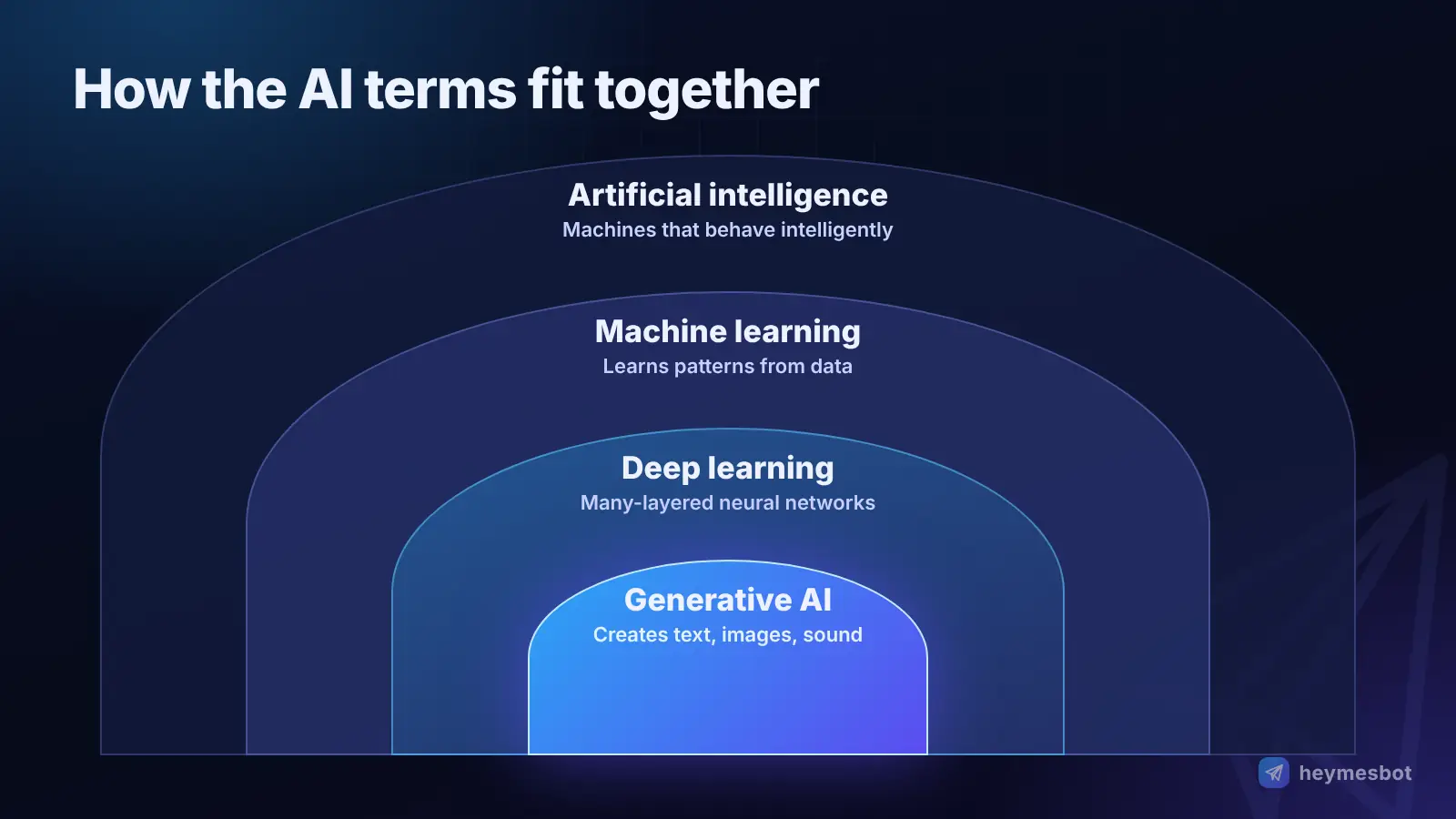
These four terms are often used interchangeably, but they are really nested circles:
| Term | What it means | Example |
|---|---|---|
| Artificial intelligence | The whole field of building machines that behave intelligently | From chess engines to voice assistants |
| Machine learning | The approach where a machine learns patterns from data | Spam filters, movie recommendations |
| Deep learning | Machine learning with many-layered neural networks | Face recognition, speech-to-text |
| Generative AI | Models that create new content | ChatGPT, image, video and music generators |
Another common split: narrow AI, which is good at one or a few specific tasks (every tool in use today is narrow AI), and artificial general intelligence (AGI), which could learn almost any intellectual task a human can. AGI is still a research goal, and experts do not agree on when it might arrive.
How does AI learn?
Almost every modern AI system, whatever it does, goes through the same four stages:
Data: text, images, audio or numbers; the more and the more varied, the better.
Training: the model makes a guess, the guess is compared with the right answer, and the error is fed back to nudge it. This loop repeats billions of times.
The model: the result of training is a file of millions to billions of numbers called parameters, in which everything the model "knows" is compressed.
Inference: the model is ready. It takes new input and produces an answer using those parameters. When you chat with a chatbot you are at this stage; the model is not learning from you in that moment.
Neural networks: the heart of modern AI
An artificial neural network is inspired by the brain but is far simpler. It is built from layers of "neurons"; each takes in numbers, combines them with different weights, and passes the result to the next layer. Early layers pick up simple patterns (edges in a photo), later layers more complex ones (eyes, faces, cats). A network with many layers is called "deep", which is where deep learning gets its name.
The idea mattered so much that the 2024 Nobel Prize in Physics went to John Hopfield and Geoffrey Hinton for foundational discoveries that enable machine learning with artificial neural networks.
How do ChatGPT and other language models work?
Tools like ChatGPT, Gemini and Claude are built on large language models (LLMs). Their core idea is surprisingly simple: predict the next word.
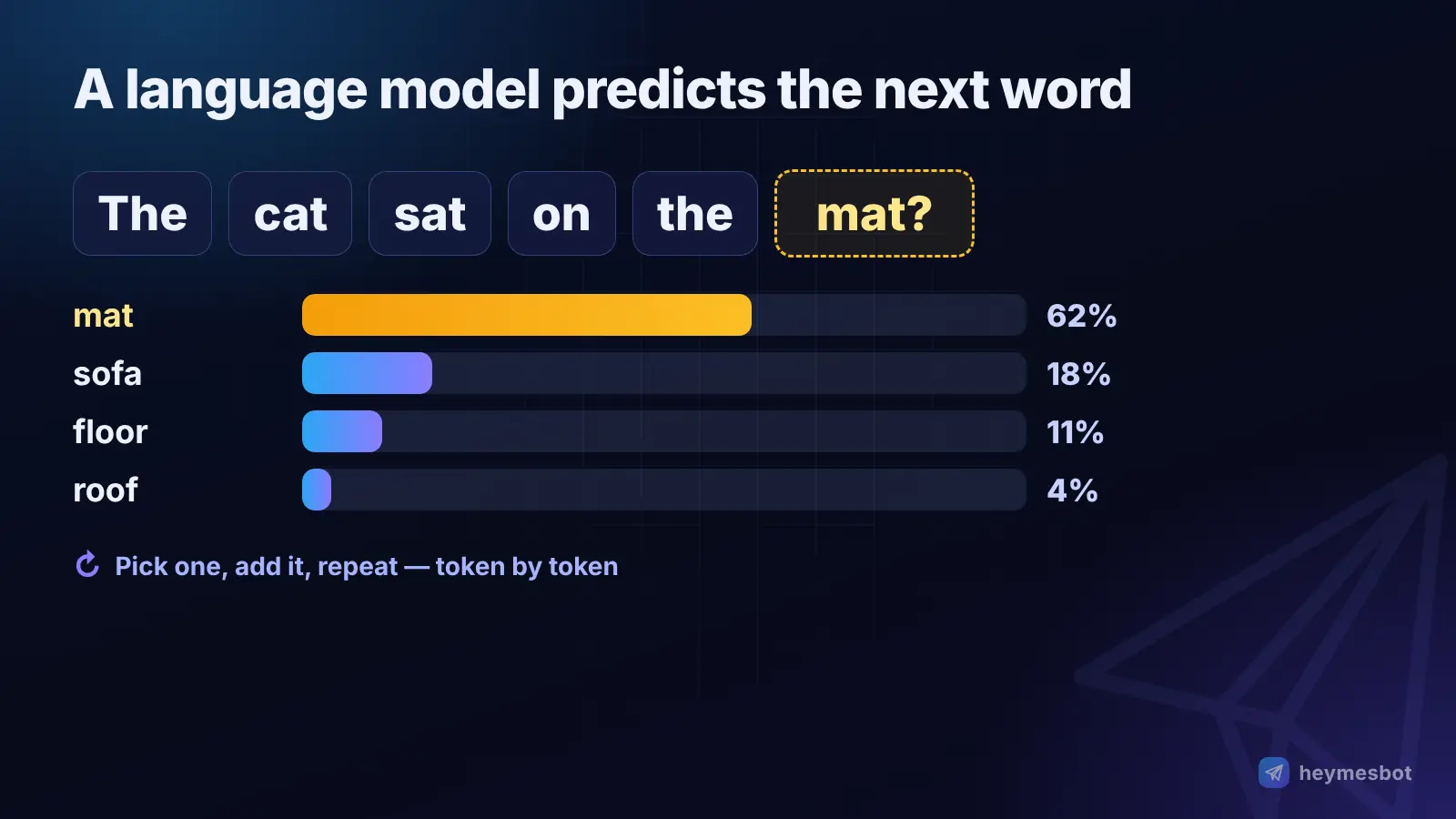
Tokens: the model breaks text into small pieces called tokens. In English one token is roughly three-quarters of a word; in many other languages a single word is usually split into several tokens.
Prediction: for the next token, the model assigns a probability to every option, picks one, appends it, and repeats. Your answer is built token by token, which is why it appears to "type" on the screen.
Transformers and "attention": the architecture introduced in the 2017 paper Attention Is All You Need. Attention lets the model work out which earlier parts of the text matter most for each prediction, for example which noun "it" refers to.
From word prediction to a helpful assistant
A raw language model only continues text. To become a helpful assistant it goes through three stages of training:
Pre-training: reading a vast amount of general text and learning the patterns of language, general knowledge and simple reasoning.
Instruction tuning: training on examples of good questions and answers so it learns to respond to requests instead of just continuing them.
Learning from human feedback (RLHF): people rank different answers, and the model learns to give more helpful, honest and harmless ones.
Why language models make mistakes
They are trained to produce plausible text, not to verify truth. When a model lacks information it can produce a fluent, well-organised and entirely invented answer, from a statistic that doesn't exist to a source that was never written. This is called hallucination. The golden rule: for health, law, money or any important decision, an AI answer is a starting point, not the final word.
How does AI create images, video and sound?
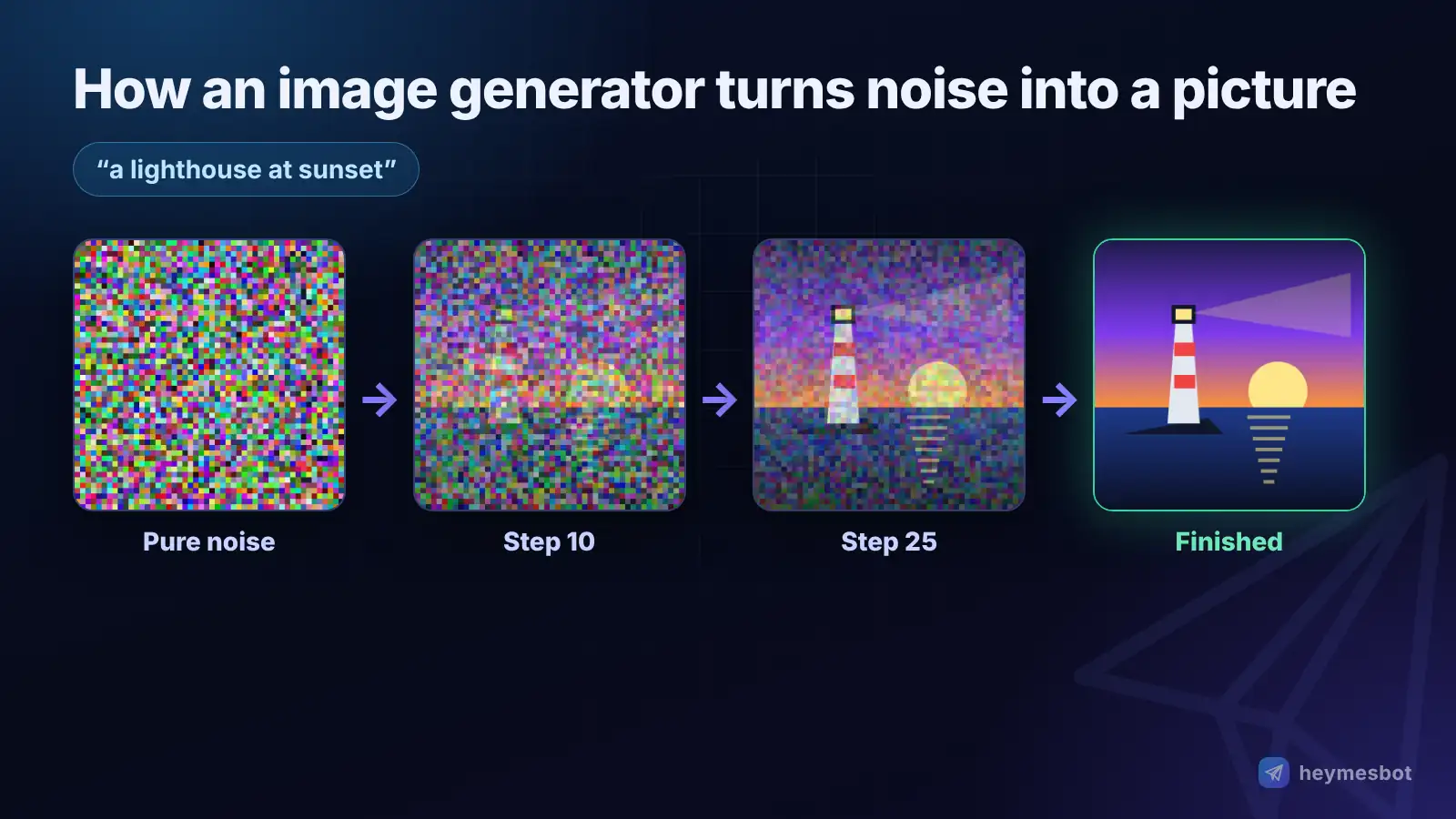
Most of today's image generators use a technique called diffusion. During training, noise is gradually added to real images and the model learns to remove it step by step. To generate, the model starts from pure random noise and, guided by your text, turns it into a clean image over a few dozen steps.
Video: the same idea applied to a sequence of frames that must stay consistent over time, which is why video costs far more to generate than a still image.
Text-to-speech: the model has learned to turn text into a sound wave with natural tone and pauses.
Music: models trained on large amounts of audio compose a piece from your description of style, mood and instruments.
Multimodal models: newer models understand several kinds of input and output together, for example looking at a photo and talking about it, or turning text into images and audio.
A short history of AI
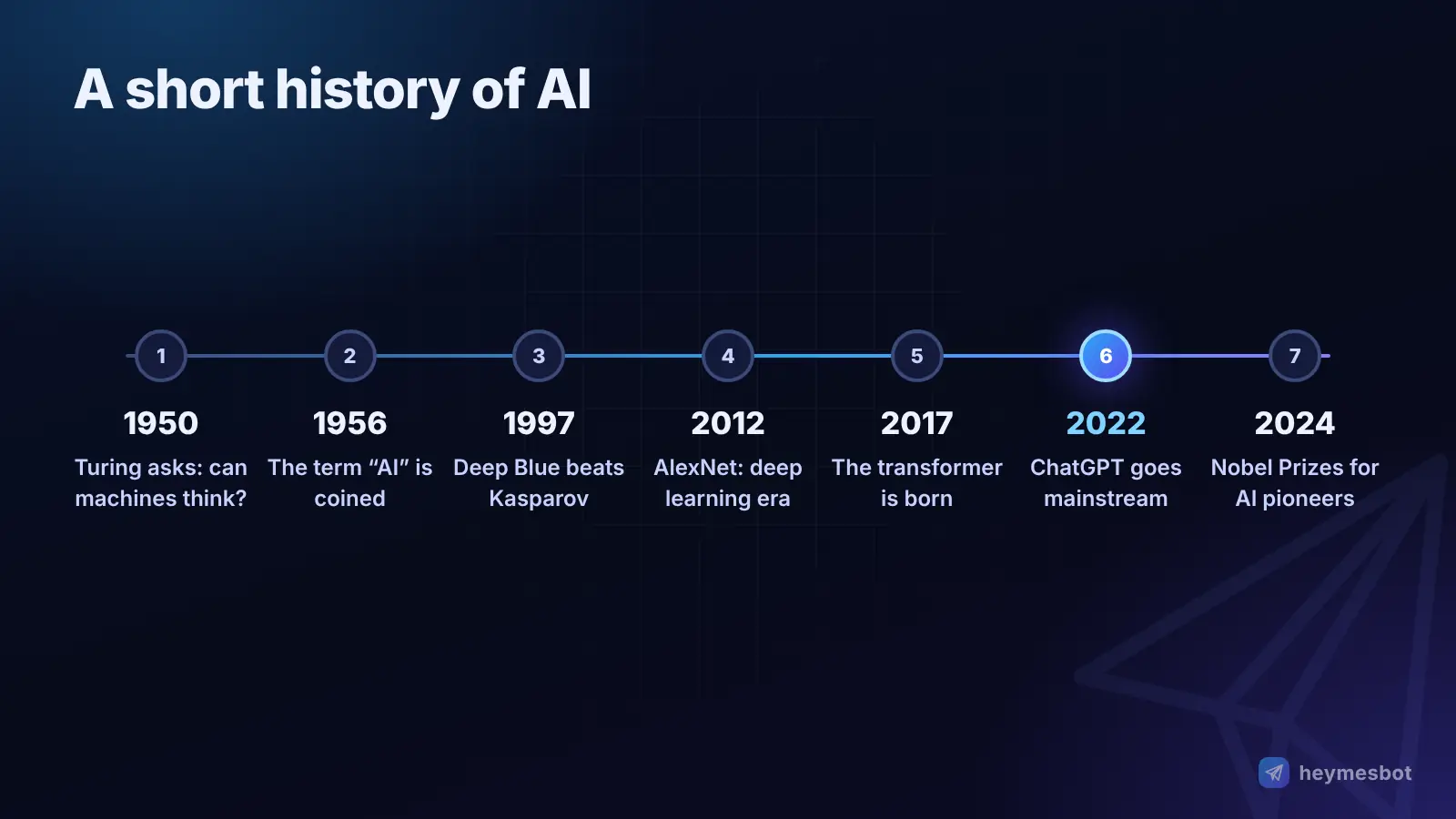
1950: Alan Turing asks, in Computing Machinery and Intelligence, whether machines can think.
1956: the term "artificial intelligence" is coined at a workshop at Dartmouth College.
1997: IBM's Deep Blue beats world chess champion Garry Kasparov.
2012: the AlexNet neural network makes a leap in image recognition and the deep learning era begins.
2017: the transformer architecture is introduced, the foundation of every large language model today.
2022: ChatGPT is released and generative AI becomes an everyday tool for millions within months.
2024: the Nobel Prize in Physics goes to neural network pioneers, and part of the Chemistry prize to the creators of AlphaFold.
Today: multimodal models and "agents" that can carry out multi-step tasks on their own. According to Stanford's AI Index 2026, generative AI reached 53% adoption within three years, faster than the internet or the personal computer.
What can AI do today?
Writing and editing: email drafts, summaries of long documents, tone and grammar fixes.
Learning: explaining a hard concept simply, creating exercises and quizzes, helping with languages.
Translation: text and even speech, with better grasp of context than older tools.
Images and design: generating images from a description, removing backgrounds, restoring old photos.
Video and audio: animating photos, making short clips, voice-overs and music.
Programming: writing and explaining code, finding bugs.
Science and medicine: predicting protein structures, helping analyse medical images, drug discovery.
Limits and risks: what gets said less often
| AI is strong at | AI is still weak or risky at |
|---|---|
| Fast drafts, summaries, brainstorming | Fact-checking; it can be confidently wrong |
| Repetitive tasks with clear patterns | Very recent information missing from its training data |
| Creating images and audio from a description | Moral judgement and decisions that carry responsibility |
| Translation and simple explanations | Completing real computer tasks without supervision |
Bias: models learn from human data and can repeat the prejudices in it.
Privacy: never paste passwords, card numbers or personal documents into any chatbot.
Fake content: realistic images, voices and videos are now easy to make; don't trust shocking content without a source. The AI Index 2026 counted a record 362 reported AI incidents in 2025.
Computer tasks: on OSWorld, a benchmark of real tasks on a computer, the best models scored 66.3%, still a little below the 72.35% human baseline, although they were at about 5% just a year earlier.
Where should I start?
You don't need to code or know maths. Pick a tool and practise with small everyday tasks:
Choose a real task: summarise an article, draft a message or explain a concept.
Write a clear request: say what you want, for whom, and in what tone and length.
Refine the answer: if it isn't right, say what to change. Have a conversation, not a one-off question.
Check it: verify any important number, name or claim against a reliable source.
There are plenty of tools: the ChatGPT, Gemini and Claude websites and apps for conversation, plus separate tools for images and video. If you'd rather have all of it in one place inside Telegram, heymesbot offers chat, image creation and editing, video, voice and music with no monthly subscription, paying only for what you use.
Keep our complete AI glossary handy for the terms you'll meet along the way.
The bottom line
AI isn't magic, and it doesn't have a human mind. It is a machine that has learned patterns from enormous amounts of data and can now write, draw and speak. The better you understand how it works, the better you can use its strengths and avoid its traps.
Comments
No comments yet. Be the first to share a thought.
Leave a comment
Comments are reviewed before they appear. Please keep it relevant and kind.